Regulation and payment rails are pulling in the same direction today, even when they look like they conflict. Japan is reclassifying crypto as a financial instrument, UK holders are organizing against banks that block their transfers, and the two largest card networks are quietly wiring stablecoins into how commerce settles.
- Japan’s Lower House passes a bill moving crypto under its securities law, with lower taxes and a path to ETFs
- 286,000 UK crypto holders launch a campaign after banks block or delay roughly 40% of crypto transactions
- Visa tells its payments forum that stablecoins are reshaping the back end of commerce
- Mastercard’s Agent Pay lets AI agents settle in USDC and RLUSD alongside cards
- DBS will sell gold-backed tokens to retail customers, one gram of vaulted gold per token
- Delaware and New Jersey advance bills to ban crypto ATMs, citing $388 million in 2025 fraud losses
The common thread is access. Some of today’s news widens it and some narrows it, but every story is a decision about who gets to own and move digital value, and on what terms.
Japan moves to regulate crypto like a financial instrument
 Source: CoinDesk
Japan’s Lower House passed a bill shifting cryptocurrency from the Payment Services Act to the Financial Instruments and Exchange Act, the same legal framework that governs stocks. The change brings lower, stock-style tax treatment, introduces insider trading rules for exchange staff and project insiders, and opens a path to domestic crypto exchange-traded funds. New disclosure requirements will ask projects to publish details on technology, token supply, and finances. The rules are expected to take effect in 2027.
The Financial Services Agency framed it as a balance: “Our framework intends to improve user protection while remaining mindful of promoting innovation.” The scale Japan is regulating for is notable. The FSA cited more than 14 million crypto accounts in the country, with around 70% held by people earning under 7 million yen a year. This is not a niche hobby being tidied up. It is a mainstream asset class being given mainstream rules.
Zypto take: Lower taxes and clearer rules are good news for anyone who already holds crypto in Japan, and the ETF door will pull in a new wave of investors who want exposure without touching a wallet. That is real participation, and it is worth welcoming. But there is a quiet distinction worth holding onto. Regulating crypto as a financial instrument optimizes it for investing, for buying an asset and watching its price. It does less for using it. The people in that 70% earning under 7 million yen are exactly the ones who benefit most when digital assets are something you can move and spend, not just hold in a brokerage wrapper. Ownership you can actually use is a different proposition, and it is what Zypto App is built around.
Source: CoinDesk
UK crypto holders organize against banks blocking their transfers
 Source: CoinTelegraph
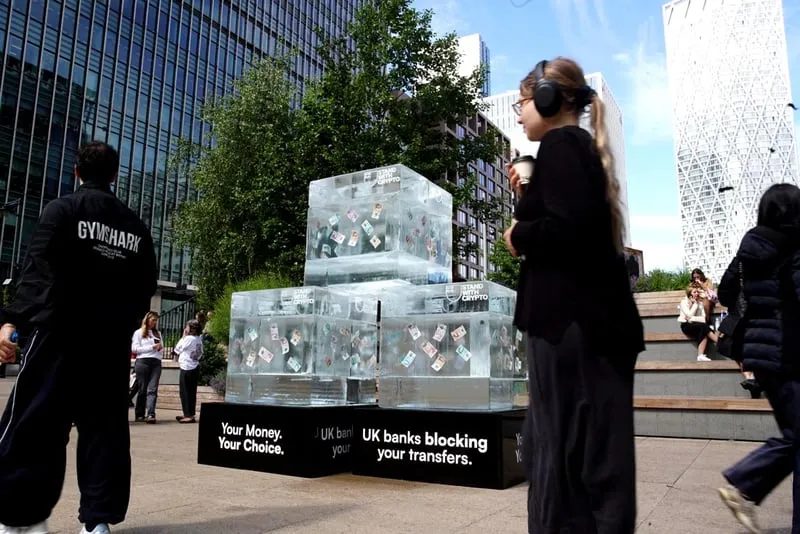
A campaign backed by 286,000 UK crypto holders launched this week, urging members to file formal complaints against retail banks that block or restrict transactions to crypto exchanges. According to the organizers, several banks now stop all transfers and card payments to exchanges outright, while others impose strict caps. The group estimates British banks block or delay around 40% of domestic crypto transactions, and says 80% of surveyed exchanges reported more transfer rejections over the past year. One platform reported banks rejecting over one million pounds in transactions in a single year.
The campaign’s framing is direct. “People across the UK are being blocked from accessing a legal asset class because banks have chosen to impose blanket restrictions on an entire sector,” said the director leading it. Crypto is legal to own in the UK. The barrier here is not the law. It is an intermediary deciding, on its own terms, what its customers are allowed to do with their own money.
Zypto take: This is what the case for self custody looks like in practice, stripped of ideology. When a third party can decide whether your money is allowed to move, you do not fully own it. You hold it at someone else’s discretion. The campaign is right to push for fairer treatment from banks, and that fight matters. But the deeper point is structural: assets you hold yourself, with keys on your own device, cannot be frozen at a bank’s discretion because no bank sits in the path. That is the whole reason self custody exists. Zypto App keeps your keys on your device across 20+ blockchains, so the question of whether you are permitted to move your value never has to be asked.
Source: CoinTelegraph
Visa says stablecoins are reshaping the back end of commerce
 Source: The Block
At its annual payments forum, Visa put stablecoins at the center of its infrastructure roadmap. “AI is transforming the front end of commerce. Stablecoins are reshaping the back end,” said chief product and strategy officer Jack Forestell. The company reported its stablecoin settlement run rate had reached an annualized $7 billion as of March 2026, and said it is extending seven-day settlement to acquirers and expanding pilots across more regions, blockchains, and currencies. Visa also introduced a tokenized deposits layer that lets banks turn traditional deposits into programmable digital money.
The headline number is worth sitting with. Seven billion dollars in annualized stablecoin settlement, running through the back end of the largest card network in the world, is no longer experimental. It is plumbing. Most of the people whose transactions flow across these rails will never know stablecoins were involved, and that is precisely the point. The technology disappears into the infrastructure.
Zypto take: Two truths can sit side by side here. Stablecoins becoming the settlement layer for global card networks is a genuine milestone, and it validates everything the industry has said about their utility for years. It is also worth being clear about where the user stands in that picture. When stablecoins settle on the back end, the value still moves between institutions, and the person at the front end is using the same card the same way they always have. The other version of this is the one where the user holds the stablecoin directly and moves it on their own terms. Zypto Pay runs on that model, letting merchants accept crypto and settle in local currency without an institution sitting between the payer and the payment.
Source: The Block
Mastercard’s Agent Pay lets AI agents settle in stablecoins
 Source: Decrypt
Mastercard launched Agent Pay for Machines, a platform that lets autonomous AI agents transact on their own, settling through cards, bank accounts, or regulated stablecoins including Circle’s USDC and Ripple’s RLUSD. More than 30 companies took part, among them Coinbase, OKX, Polygon, RippleX, Aave Labs, Stripe, Cloudflare, and the Solana Foundation. “Machine payments can make it possible for services to be bought and sold among agents at fundamentally different scales than payments today,” said chief product officer Jorn Lambert, describing very high volumes of very small, very fast transactions.
The choice of stablecoins here is not incidental. Machine-to-machine payments need a settlement medium that moves instantly, around the clock, in tiny amounts, without waiting on banking hours or batch windows. That describes a stablecoin far better than it describes a card rail. The AI framing grabs the headline, but the durable signal underneath is that when payments have to be fast, programmable, and continuous, the industry reaches for stablecoins by default.
Zypto take: Strip away the agents for a moment. What this confirms is that stablecoins have become the obvious answer whenever value needs to move quickly and continuously, whether the sender is a machine or a person. That same property, value that moves on demand without waiting on an intermediary’s schedule, is exactly what makes stablecoins useful for a human sending money across a border or paying for something abroad. The infrastructure being built for agents is the same infrastructure people will use directly. Holding and moving stablecoins yourself, rather than through a settlement layer you never see, is where that utility lands for an ordinary user.
Source: Mastercard
DBS will sell gold-backed tokens to retail customers
 Source: CoinDesk
Singapore’s DBS Bank will offer Physical Gold Tokens to retail customers in the second half of 2026, each token backed by exactly one gram of physical gold held in a Singapore vault. Customers will buy and hold the tokens through the bank’s retail app, with DBS handling tokenization, issuance, distribution, and custody in-house. The bank’s investment product head framed the move as widening access: physical gold has largely been the preserve of institutional and accredited investors, while retail customers were limited to gold funds. Last year DBS tokenized structured notes on Ethereum and listed a tokenized money market fund.
Real-world asset tokenization spent years as a slide in conference decks. Gold split into one-gram tokens, sold to ordinary customers through a bank app they already use, is the version where it finally touches a regular person. The asset is old and familiar. What changes is that ownership becomes divisible, portable, and digital, available in fractions that a physical gold market never made practical.
Zypto take: This is ownership being unbundled from the gatekeepers who used to control it, and that is a genuinely good direction. Splitting a vaulted asset into gram-sized tokens means someone with modest savings can own real gold for the first time, not a fund’s claim on it. The open question is what happens after you own it. A token that lives only inside one bank’s app is a starting point, not the finish line. The fuller promise of tokenized real-world assets is that they can move and connect across an ecosystem, which is the direction real-world assets are heading. Divisible ownership is the breakthrough. Portable, usable ownership is where it gets interesting.
Source: CoinDesk
Delaware and New Jersey move to ban crypto ATMs
 Source: CoinTelegraph
Bills to ban crypto ATMs advanced in two more US states this week. Delaware’s House Bill 441 cleared committee and would prohibit owning, installing, or operating the kiosks, with a 90-day removal window. New Jersey’s S2141 passed a Senate committee unanimously. Both follow Indiana, Tennessee, and Minnesota, which enacted bans earlier this year. Lawmakers cited FBI figures of nearly 13,500 complaints in 2025 tied to $388 million in losses, with more than half of complaints coming from people over 50. They also pointed to fees running as high as 20%, against 0.4% to 1% on online exchanges.
The fraud concern is legitimate and the victim data is hard to argue with. Crypto ATMs have been a favored tool for scams that target older, less technical people, and a 20% fee on a confused first-time buyer is genuinely predatory. The complication is that these kiosks are also one of the few cash-to-crypto on-ramps that does not require a bank account, which is precisely why vulnerable users and underbanked users both end up at the same machine.
Zypto take: Banning the kiosks treats a real harm, and no one should defend a scam pipeline. But the underlying need does not disappear with the machine: people without easy bank access still want a way to turn cash into digital value. The honest response is not to mourn the crypto ATM. It is to build cash on-ramps that are safe, fairly priced, and ID-verified rather than anonymous and exploitative. Zypto already does cash access through the USDC to Cash feature, where users can cash in or cash out of USDC at participating MoneyGram locations, a regulated counter rather than an unmonitored box on a wall. Remove the predatory option, and the answer is a better one, not no option at all. Download Zypto App.
Source: CoinTelegraph
Key Takeaways
- The big institutions are converging on stablecoins as settlement infrastructure. Visa’s $7 billion run rate and Mastercard’s agent payments are two views of the same shift: when value needs to move fast and continuously, the rails are increasingly stablecoin rails.
- There is a recurring gap between exposure and use. Japan’s securities reclassification and DBS’s gold tokens both widen access to owning digital value, but owning an asset inside an institution’s wrapper is not the same as being able to move and use it freely.
- Who controls access is the quiet theme running under everything. UK banks blocking transfers and US states banning kiosks are both intermediaries deciding what people may do with a legal asset. Self custody exists precisely so that decision stays with the owner.
- Real-world utility keeps proving itself in mundane places. Gold by the gram, cross-border settlement, machine micropayments: the wins are practical, not theatrical.
- The infrastructure being built for institutions and machines this week is the same infrastructure that, held directly, gives an ordinary person ownership they can actually use. The interesting question for the rest of 2026 is how quickly that reaches the front end, where people live.