Crypto is turning up inside systems people already use. A visitor in Japan scans the same QR code as a local, a Brazilian fund register is mirrored onto a public ledger, and small stablecoin transfers keep crossing Southeast Asian borders.
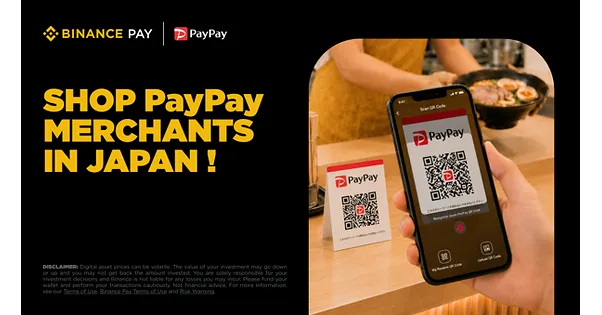
- About 48 million overseas Binance Pay users can now pay at PayPay merchants across Japan, and the shops are settled in yen.
- Brazil’s CSD BR, which oversees roughly $4 trillion in assets, is copying BTG Pactual fund ownership records to the XRP Ledger.
- AllUnity, a MiCA-regulated issuer, announced USDAU, a dollar stablecoin headed for six networks.
- Chainalysis counted 5.4 million small peer-to-peer transfers across the Philippines, Thailand and Vietnam.
Each of these plugs crypto into a place money already moves. The person paying or holding gets a familiar experience, and the blockchain does its work underneath.
Binance Pay reaches PayPay shops in Japan
 Source: PR Newswire
Binance opened PayPay-supported merchants in Japan to overseas Binance Pay users from September 30. About 48 million eligible users from more than 100 countries and regions can pay across dining, shopping, accommodation and other travel purchases at millions of merchant locations, while the merchants keep receiving settlement in yen.
The connection runs through HIVEX, a framework that links overseas QR payment services to PayPay’s network, and Binance says it’s the first crypto payment service to reach PayPay merchants that way. It’s built for inbound travelers, so Japan residents can’t use it.
Zypto take: A traveler paying a local shop from a crypto balance, with the shop seeing ordinary yen, is the kind of crypto use that needs no explaining. Zypto App lets you pay abroad the same way: hold USDC or USDT yourself and pay local merchants over Pix and Nequi.
XRP Ledger carries Brazil fund records
 Source: CoinDesk
CSD BR, a regulated Brazilian financial-market operator with more than 22 trillion reais (about $4 trillion) in registered assets, started copying fund ownership records to the XRP Ledger together with Ripple. The records cover selected funds from BTG Pactual, Latin America’s largest investment bank.
CSD BR’s own database remains the official record for registration, custody and settlement, and the operator runs identity and AML checks on token holders. The onchain copy lets approved institutions verify ownership changes as they happen. Direct issuance and trading on the XRP Ledger could come next, possibly including real estate and agribusiness receivables.
Zypto take: For now the ledger is a mirror, and the operator’s database still holds the legal record, which is a sensible first stage for market infrastructure. The step CSD BR has already named is the one to watch: issuing the assets directly onchain, which is where real world assets turn into something a wallet can hold.
AllUnity adds a dollar stablecoin in Europe
 Source: Cointelegraph
AllUnity, a European stablecoin issuer operating under MiCA, announced USDAU, a dollar stablecoin held 1:1 against segregated reserves. It’s set to launch on Ethereum, Solana, Base, Tempo, Arc and Polygon, and it’s the company’s fourth fiat-backed token after EURAU, CHFAU and SEKAU. No launch date was given.
The target is European companies that need dollars for global trade and cross-border payments. CEO Alexander Höptner said Europe’s concern is dollar liquidity “flowing through offshore issuers with no European supervisor”.
Zypto take: USDAU sits in the same tier as USDC and USDT: an issuer sets its terms, and you can still hold it in your own wallet and move it where you need it. Six networks at launch makes the moving part count, and Zypto’s crosschain swaps already run across four of them: Ethereum, Solana, Base and Polygon.
Chainalysis maps Southeast Asia’s stablecoin use
 Source: Cointelegraph
Chainalysis data put Singapore back at the top of Central and Southeast Asia and Oceania: its crypto economy grew 55.4% to $284 billion in the year ended June 2026, led by a 94% jump in institutional platform activity to $60 billion. The region as a whole contracted 6.8%.
The everyday story sits further down. The Philippines, Thailand and Vietnam recorded a combined 5.4 million peer-to-peer transfers under $10,000, and across the region cross-border stablecoin activity was 3.2 times larger than domestic activity. Thailand and Vietnam also hosted domestic stablecoin markets of $10.4 billion and $6.9 billion.
Zypto take: Millions of small transfers crossing borders is remittance with people choosing the route themselves. Zypto App lets you pay a bill for someone in another country straight from your wallet, and the Philippines is one of its key bill pay markets. Download Zypto App.
Key Takeaways
- Crypto reaches a shop counter most easily through payment networks the shop already accepts, with settlement arriving in local currency.
- Market operators are putting records onchain before the assets themselves, and Brazil’s CSD BR has said the assets come next.
- Before you hold a stablecoin, it pays to know who issues it and on what terms, and then where it can travel.
- In the Philippines, Thailand and Vietnam, stablecoins are carrying millions of small transfers between countries.
- As more of these connections open, the question for the person paying shrinks to which balance to pay from.
Related topics